

Research & evaluation
Our research represents the voice of food-insecure families.
Families tell us how our fresh approach improves their lives in many more ways than traditional, food-based responses.
The results of our study validated iCAN’s decision to transition to grocery gift cards as the sole vehicle of support for food-insecure children and families across Calgary.
This study is the first of its kind. The University of Calgary and the O’Brien Institute for Public Health conducted in-depth research on how our grocery gift card approach impacts children and families living with food insecurity, as well as the agency partners who help target our program. We summarize all the study results below. You can also discover more here:

The case for gift cards
During interviews with study participants, the University of Calgary researchers learned that all recipients prefer to access grocery gift cards rather than free food hampers. Here’s why:
Benefits for agency partners
We conduct a comprehensive program evaluation with our agency partners each year. There continues to be full alignment between the insights they shared with the U of C research team and the feedback they provided in our most recent evaluation. Here is what our partners tell us about our grocery gift card program:
Logistics and resourcing
- Requires no physical space or refrigeration to store food and food hampers.
- Removes the burden of assembling and distributing food hampers to families in need.
- Eliminates the need to monitor, manage, and dispose of donated food waste.

Enhanced client interactions
- Creates interest and discussion so they can assess and target the families most in need.
- Frees up more staff time to work directly with clients.
- Provides a way to explore and address other needs with clients, such as support for their mental health or guidance around their job searches.

Improved client experience
- Strengthens trust, engagement, and rapport with clients.
- Causes no stress for clients because they do not have to fill in application forms.
- Makes it much easier for clients with language barriers to understand and ask for the support.

One of the really positive sides of grocery gift cards is that it’s connected me with families in the community that I wasn’t connected with before. I also had more conversations with families that have been getting gift cards.
The efficiency factor
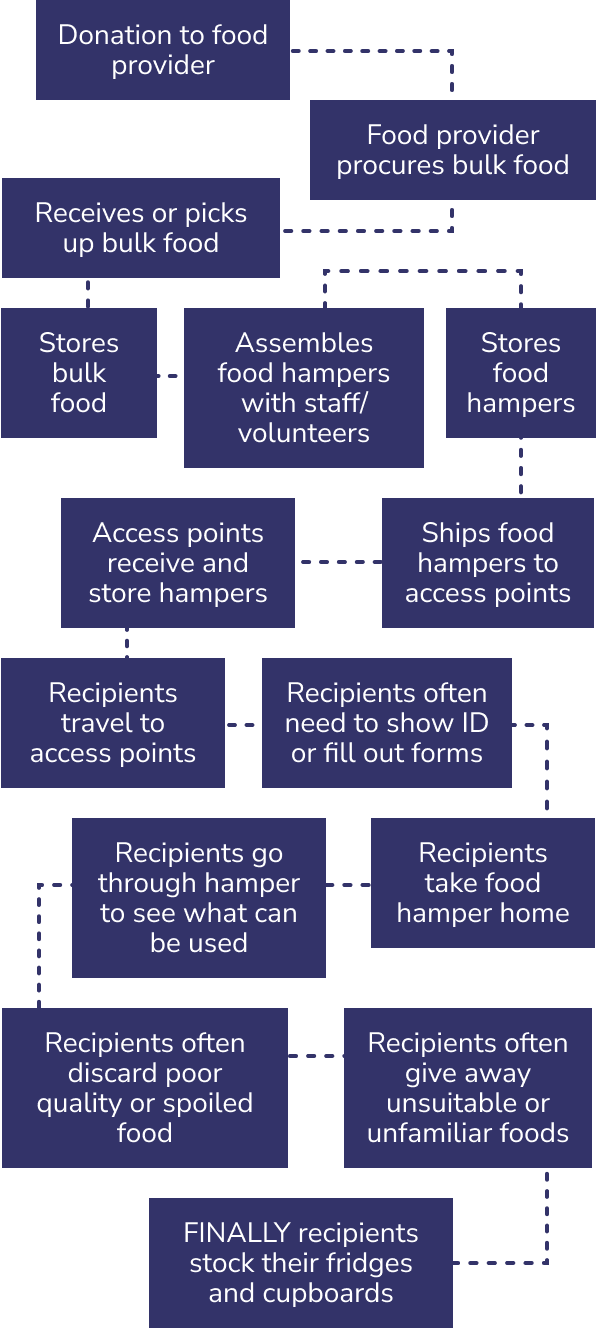
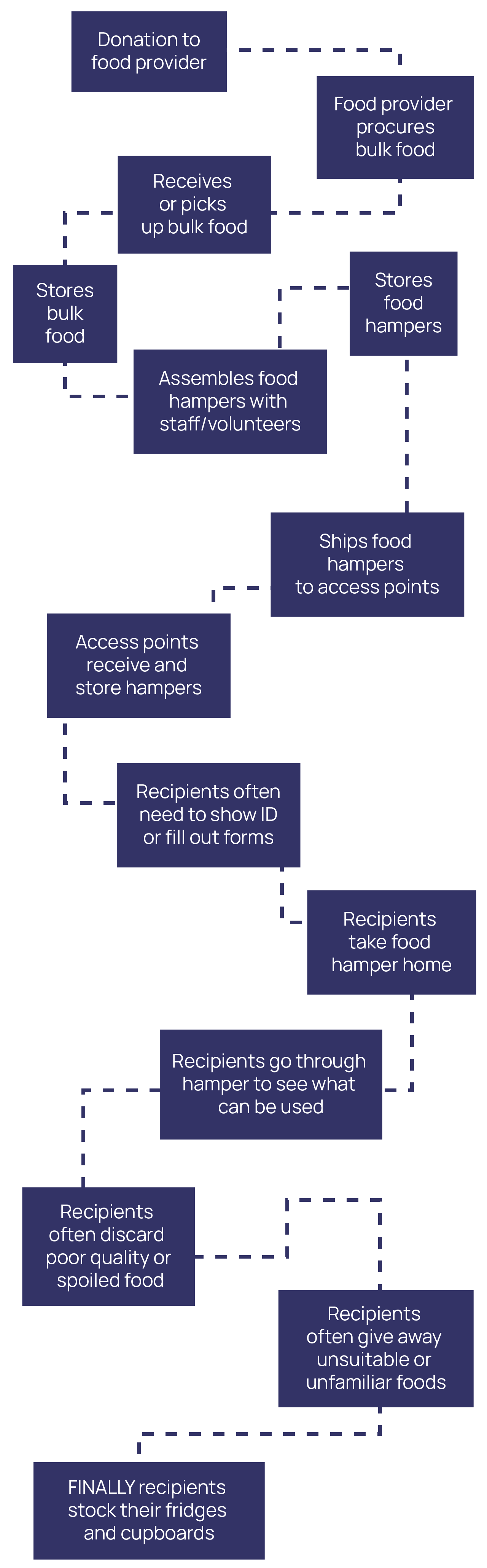
Free food hampers
There’s a lot that goes on between a donation and getting food to hungry kids. Free food provision is much more impersonal, stigmatizing, and wasteful. It focuses less on relationships and choice, and more on transporting and assembling bulk quantities of food around the city.
VS
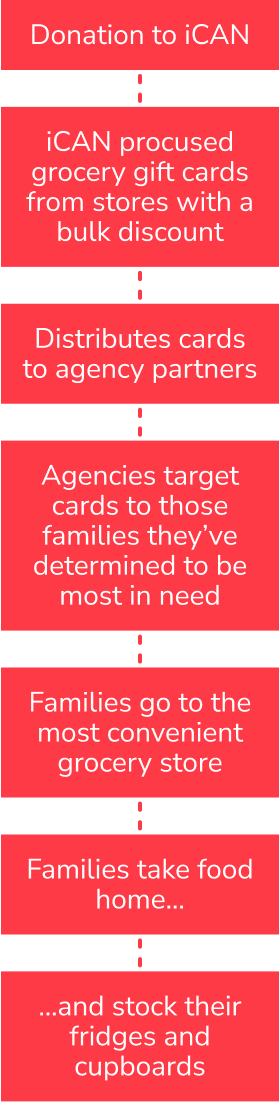
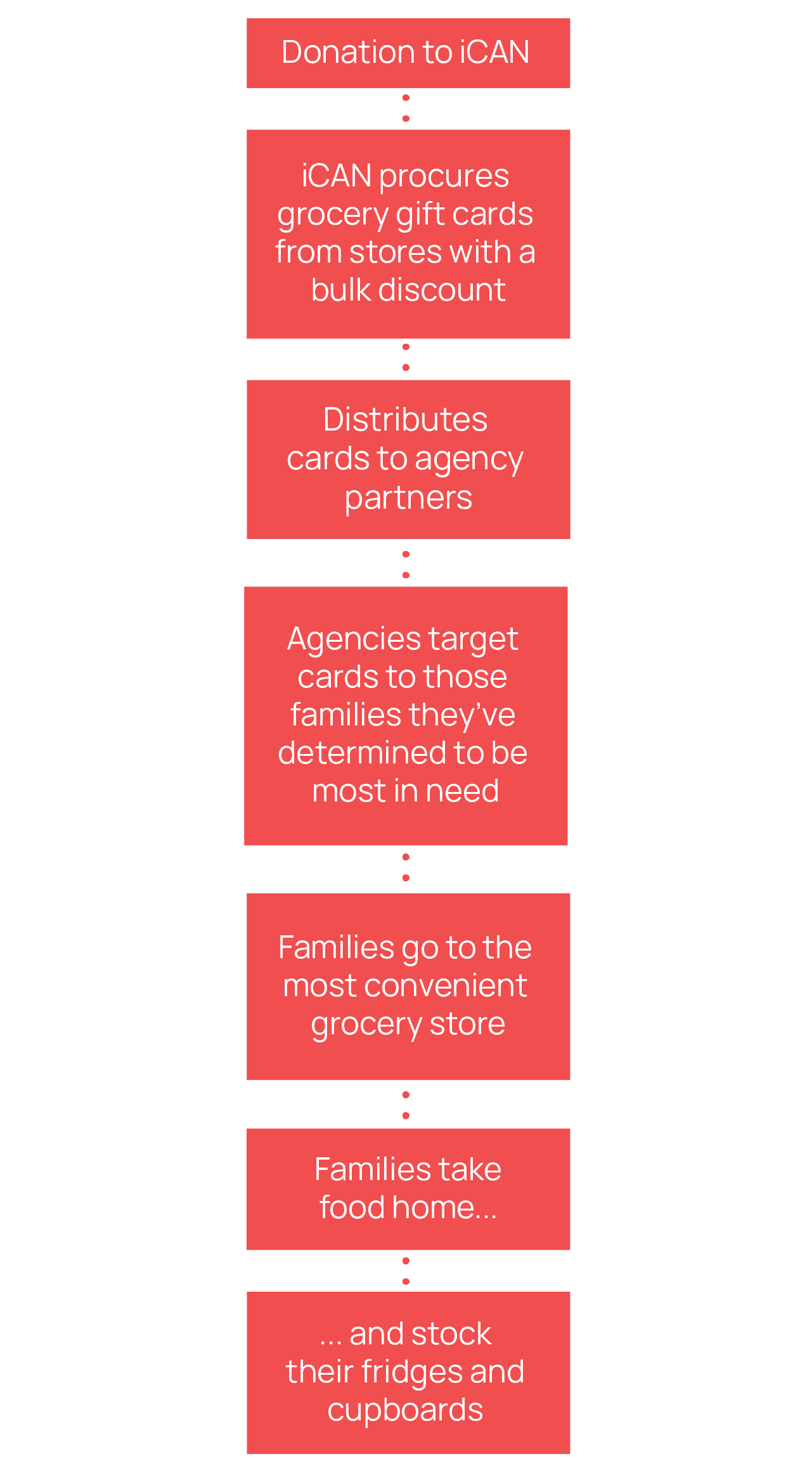
Grocery gift cards
Your contribution quickly empowers families to gain control over their struggles. Our process is driven by direct relationships: you to us, us to agency partners, agency partners to families in need. We’ve built circles of trust that help it all go smoothly.
Click to compare
Grocery gift cards
Your contribution quickly empowers families to gain control over their struggles. Our process is driven by direct relationships: you to us, us to agency partners, agency partners to families in need. We’ve built circles of trust that help it all go smoothly.
Free food hampers
There’s a lot that goes on between a donation and getting food to hungry kids. Free food provision is much more impersonal, stigmatizing, and wasteful. It focuses less on relationships and choice, and more on transporting and assembling bulk quantities of food around the city.

New clients often initially connect with us due to unforeseen financial crises. Being able to help them with food insecurity enables us to start working on the deeper issues to stabilize the situation and then move forward with long-term financial goals. Adults in the home feel supported and understood so they can build trust with our organization. Clients express how the gift cards lift a weight off their shoulders.
We used to give food to hungry kids. Now we empower families to feed themselves.
Become a part of the innovation today!